“Listen, my children, and you shall hear / Of the midnight ride of Paul Revere.” – Henry Wadsworth Longfellow
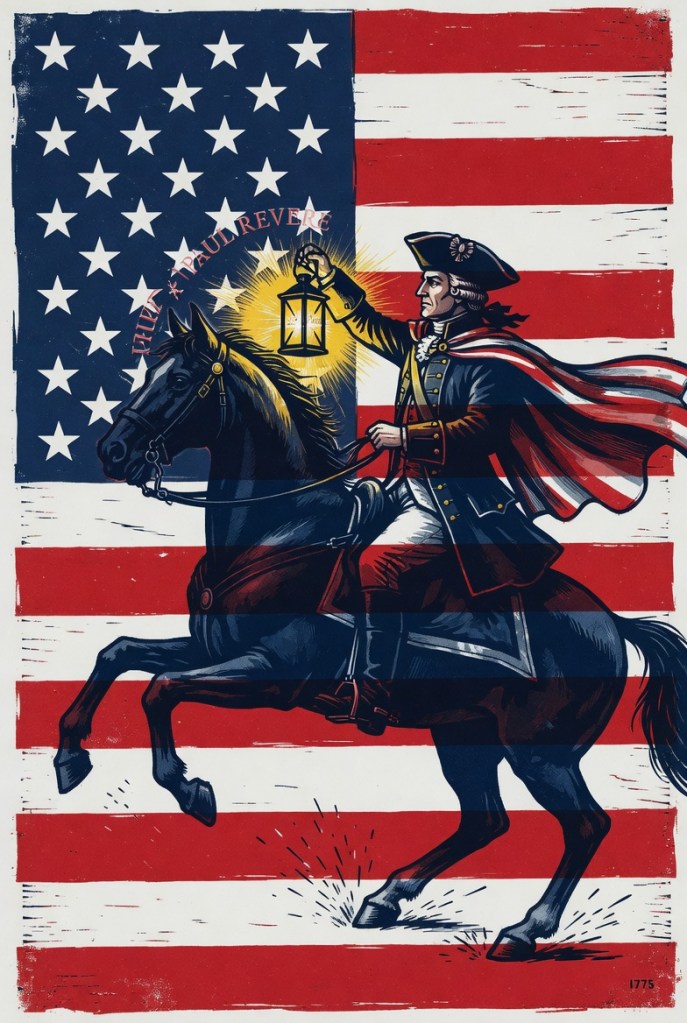
Unarguably, one of the most familiar stories of the American Revolution began 251 years ago this evening; Paul Revere’s daring ride to warn militias along the road to Lexington that a contingent of British soldiers were headed to Concord. The story might not have become legend had Longfellow not memorialized Revere’s ride in his famous poem 85 years after the events began on April, 18th, 1775. Historical fiction embellishes, and the poem, geared toward children, with its lyrical, rhyming cadence was like an after-school special based on real events, or a top-ten Billboard single. The true story is not as simple, nor without danger and intrigue.
Paul Revere, as a silversmith, was one of the Mechanics, who were a small, secret group of tradesmen and artisans somewhat flying under the radar of the British, as well as a member of the Sons of Liberty. The Sons operated out in the open as activists. The British thought them an annoying gang of rabble rousers. The Mechanics (also known as Liberty Boys) were a small group of tradesmen and artisans. The Mechanics were respected members of the community, allowing them to be in a position to form an intelligence network for the burgeoning revolution. The group patrolled at night as a neighborhood watch, spying on troops, noting their movements, and putting themselves in positions to overhear information, which was funneled to the Provincial Congress and Dr. Joseph Warren of the Committee of Safety.
In mid-April, the revolutionaries developed information that the British were preparing a covert operation to confiscate weapons, ammunition, and supplies from the militia’s stockpile at Concord. As the British operation commenced, Dr. Warren alerted Revere, who had arranged for the signal in the church belfry in case his ride was disrupted. One if by land, two if by sea. The British decided to cross the Charles River by boat, rather than moving through the narrower land route. As the signal was set, Revere began the dangerous crossing in the shadow of a warship. William Dawes left by traversing the narrow strip of land through the British checkpoint.
Once on shore, Revere confirmed the backup signal had been seen, and then borrowed a horse beginning his ride to Lexington, rousing patriots along the way. In Lexington, Revere, Dawes, and other riders spread out, carrying the alarm, and the militia organized to meet the British. Revere was caught on the way to Concord as Dawes escaped. Neither man reached Concord.
The British company of 700 weren’t nimble. They arrived in Concord almost 7 hours after Revere and Dawes. This gave the patriots time to move their supplies and muster a response. The British underestimated the Sons of Liberty, Liberty Boys, and patriots. It wouldn’t be the first time they did so.
Revere was captured, and with a gun to his head confessed riders had already dispersed to warn Concord. He was taken back toward Lexington and released after soldiers heard gunfire. Convinced Revere told the truth, they confiscated his mount and released him. He walked to Lexington, witnessed the skirmish at the green later that morning, accompanying John Hancock and Samuel Adams from Lexington. Dawes escaped capture, was thrown from his horse and though uninjured, didn’t make Concord either.
So yes, Paul Revere has gotten all the credit, but it was still a dramatic and dangerous night, ushering in the first official confrontation of the American Revolution.


Leave a Reply