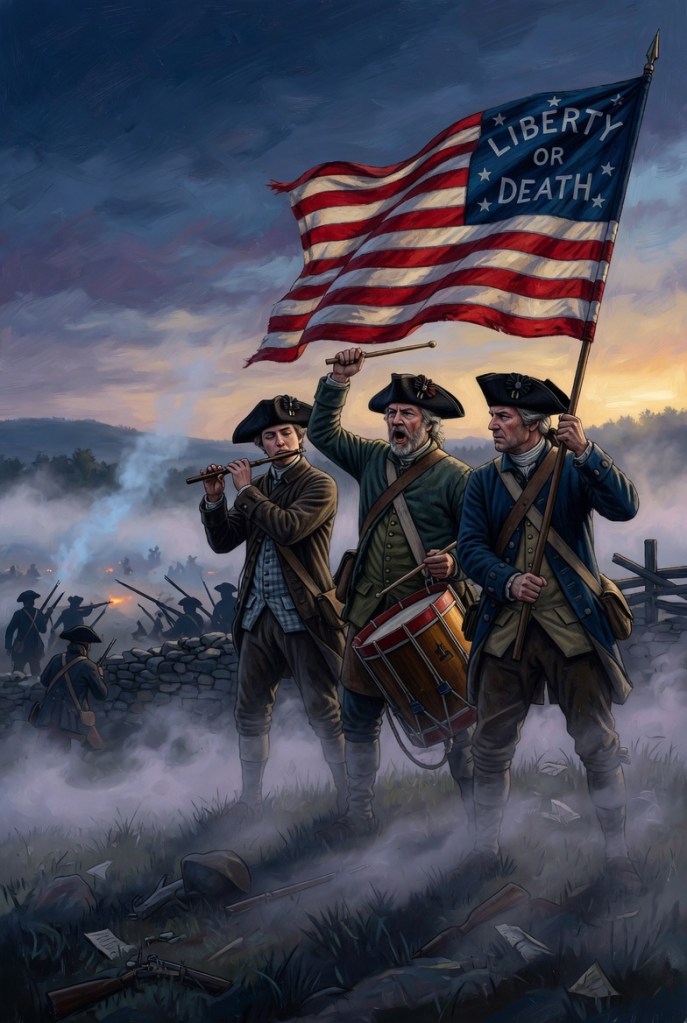
Throughout the early morning of April 19, 1775, a British column marches from the swampy banks of the Charles River, through rain and chill, toward Concord. Their mission is to confiscate arms, munitions, and supplies stored in the town by patriots. After capturing Paul Revere, they realize the mission is no longer covert.
The patriots, led by Captain John Parker, had the luxury of time due to the warnings from Revere, Dawes, and Prescott. Minute Men, trained and paid by provincial congresses, safety committees, and towns, drilled regularly. A few of the officers, including Captain Parker, had fought in the French and Indian War, and they trained their troops in the British style of column fighting. The more informal militia trained less often. Parker was a farmer, local leader, and militia captain.
As the British column made its way toward Lexington, it split. An advance guard of light infantry, numbering about 250 men, was led by the second-in-command, Major John Pitcairn. The major was well respected and liked in Boston by locals and patriots alike. He was described as even-tempered and had a reputation for de-escalating conflicts. He led his detachment to Lexington Green, while the main contingent, commanded by Lieutenant Colonel Francis Smith, continued toward Concord and the primary mission of confiscating supplies.
Expecting a quick operation, the British column would have been lightly supplied. The men, weighed down by sodden wool uniforms, were muddy, tired, and hungry. Throughout the march, a persistent wave of alarm bells and signal guns preceded them—a noise carried on the night air that announced their no-longer-covert mission. Their simple task had become annoyingly public.
By 5:00 a.m. on April 19, the rain had stopped, and the sky had cleared to a cool morning. Major Pitcairn reached Lexington Green, where he found Captain Parker and the militia arrayed opposite them.
Parker reminded his troops to hold their fire in order to conserve their limited arms and ammunition. Pitcairn shouted commands for the militia to lay down their arms and disperse. After-action reports note his increasing volume and belligerence as he called insults across the field. Parker ordered his men to disperse rather than fire first. A shot rang out, and its reverberation changed history.
Major Pitcairn called for his troops to hold, but the British responded with a volley that killed eight militiamen and injured ten. Only one British soldier was slightly wounded. In the aftermath, the British continued on to Concord.
Militia companies began arriving in Concord, and their numbers swelled to about 400. A contingent of British guarded the North Bridge while the rest of the force searched the area—including homes and farms—for munitions. Captain Isaac Davis’s company responded after seeing smoke, thinking the town was burning.
Around 10:00 a.m., the two sides met again at the bridge. The British fired first, and the militia, commanded by senior officer Major John Buttrick, gave the order to return fire. This was the first time the patriots were called upon to fire in formation. Three British soldiers were killed and nine injured. The British then ordered a retreat back across the bridge. Two patriots were also killed. This was the first victorious action for the militia, but it came at a price.
Captain Davis, a 30-year-old gunsmith and farmer, father of four and husband to his young wife Hannah, marched without hesitation. As he left, he reportedly told his wife goodbye and asked her to take good care of the children.
The British retreated into Concord as more militia continued to pour into town, their strength now between 500 and 600. Lt. Col. Smith realized the situation had deteriorated, and he prepared for a retreat back to Boston.
Smith was described as a portly commander—cautious and deliberate—but he had underestimated the rebels. His company would have been decimated without the relief column led by Brigadier General Hugh Percy. Despite the missteps, General Gage defended Smith, who was later promoted to brigadier general.
Lord Percy was an aristocrat and a field commander (he would eventually become the 2nd Duke of Northumberland). He and his 1,000 troops raced from Boston to provide cover for Smith’s retreat. Percy organized a fighting withdrawal as the confident militia—now numbering around 3,000—began attacking from covered positions behind walls, houses, and trees. This was one of the first battles to feature the colonists’ informal style of fighting. The British suffered heavy casualties. Major Pitcairn’s horse was shot out from under him, and he later complained about losing a pair of prized pistols when the baggage was abandoned.
At 8:00 p.m., the British limped into Charlestown, protected by the guns of the Royal Navy. Percy’s discipline saved the British from outright disaster, but they had lost men and equipment in the humiliating retreat.
Aftermath
British casualties: 73 killed, 174 wounded, 53 missing/captured.
Patriot casualties: 49 killed, 39 wounded, 5 missing.
The news spread through the colonies, and the newly confident militia mustered 15,000–20,000 men. The siege of Boston—and the war—had begun.


Leave a Reply