Please take a moment at 3:00 PM on Monday, May 25 to honor all those who sacrificed their lives for the freedoms we often take for granted.
Memorial Day’s first incarnation was created in 1868. On Decoration Day, the custom of placing flowers and other decorations on graves was adopted as a remembrance of all Americans killed during the Civil War, both Union and Confederate. It was expanded and adopted by states up to and until 1971, when the Uniform Monday Holiday Act established it as the last Monday in May. This year, the holiday has added significance as we celebrate America’s 250th birthday.
Since before July 4, 1776, men and women, volunteered or conscripted, have written America a blank check, payable to us, not only in defense of American freedoms but in defense of other countries as well. One of the first patriot martyrs was Dr. Joseph Warren.
Joseph Warren was born 1741 in Massachusetts. He attended Harvard College. Upon graduating he taught for a year then went back for a post-graduate degree in Master of Arts. For his thesis, he argued in defense against the proposition that all disease was caused by obstruction of bodily vessels. His argument went against medical consensus at the time, a practice we are horrified by today, bloodletting by way of leeches. He was progressive, both as a doctor, and politically. Living in Boston, he joined the Freemasons, where he met Paul Revere, who was also a Mason, Samuel Adams, and John Hancock.
In the two decades leading up to the Revolutionary War he became a leader of the Sons of Liberty, wrote articles under the pseudonym A True Patriot, and delivered speeches in commemoration of the Boston Massacre. He drafted the Suffolk Resolves, to advocate for resistance to British Parliament’s Coercive Acts, was appointed president of the Massachusetts Provincial Congress, and was a top member of the Committee of Correspondence. Well regarded and respected, he was able to develop a spy network, receiving information that the British were going to raid the munitions’ depot in Concord and possibly arrest Samuel Adams, and John Hancock. He recruited Revere and Dawes for the midnight rides to warn that the British were on their way.
The morning troops marched toward Concord, Joseph followed and as the British were in retreat after the skirmish on the green, he led the militia harassing the retreating British. A musket ball nearly killed him that day, striking his wig. His activities were becoming more dangerous, and his mother reportedly begged him to stop risking his life. Joseph answered,
“Wherever danger is near, dear mother, there will your son be. Now is no time for one of America’s children to shrink from the most hazardous duty. I will either set my country free or shed my last drop of blood to make her so.”
Dr. Warren was commissioned as Major General on June 14, 1775. During the next few days, patriots built a fort of earth on Breed’s Hill, just south of Bunker Hill. Arriving in Charlestown as a General, Joseph Warren was expected to direct and organize troops. Newly commissioned, he decided the other officers were more experienced, and he fought as a private on Breed’s Hill. The patriots rebuffed the British twice as they made their way up the hill. During the fight, Joseph rallied his brother patriots, shouting more than once,
“These fellows say we won’t fight. By heavens, I hope I shall die up to my knees in blood.”
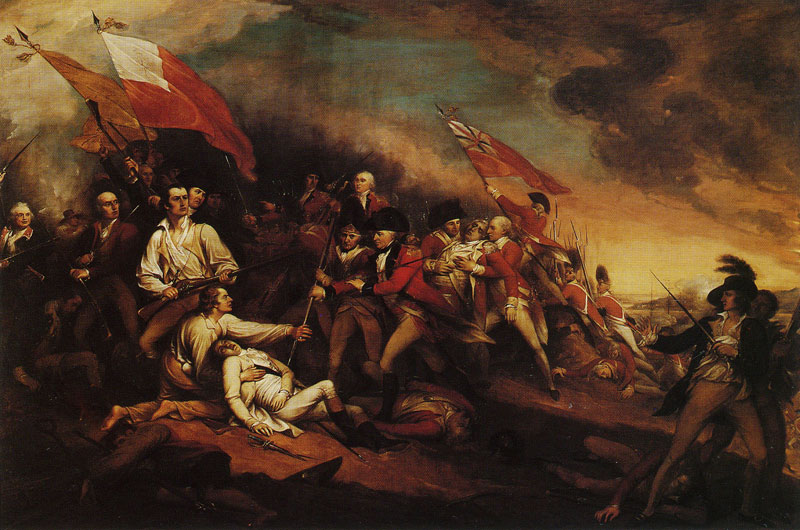
The third assault resulted in a retreat by the defenders, during which Joseph Warren was shot and killed.
The British took the hill and buried him in a shallow grave. Accounts from British soldiers described them exhuming his body, desecrating and mutilating it while gloating over his death. General Thomas Gage was said to have declared his death worth that of 500 ordinary rebels.
Dr. Joseph Warren was viewed by many Americans as a martyr. Paul Revere spent months searching for his friend’s grave, finally identifying him by dental work Revere himself had done. He was interred, then re-interred twice more, at St. Paul’s Church in Boston and his final resting place in the family vault in Forest Hill Cemetery, Boston.
A widower, Joseph’s fiancée, Mercy Scollay, raised his four children with assistance from Benedict Arnold, John Hancock, Sam Adams and the Continental Congress. Joseph Warren’s younger brother, John, also served in the war and went on to found Harvard Medical School.
Across the United States today, Towns, counties, streets, and statues, memorialize his contributions in being instrumental to the birth of the United States of America.
His death was memorialized in a painting called The Death of General Warren at the Battle of Bunker’s Hill, June 17, 1775, by John Trumbull.
Information in this post was compiled from the following sources. Read more about our first patriot martyr below.
https://en.wikipedia.org/wiki/Joseph_Warren


Leave a Reply