250 years ago 56 men committed high treason.
They were privileged, wealthy, and owned property. Their families were prosperous. As British subjects, they would have continued to be so.
They risked everything, as they pledged their lives, their fortunes and their sacred honor.
The penalty was not just death by hanging. They would have been hanged until not quite dead, disemboweled while alive, cut into quarters, and their remains would have been scattered. No final resting place. Their families penniless and shamed. Many did die, lost children or wives. They were hounded and tortured when caught. It was because they believed in these words.
“We hold these truths to be self-evident, that all men are created equal, that they are endowed by their Creator with certain unalienable Rights, that among these are Life, Liberty, and the pursuit of Happiness.”
The sentence launched a country, a purpose, community, shared values, and a radical experiment with a less than 10% chance of succeeding.
But let’s back up. How did this document get drafted? If you’re like me, it takes 1,000 words to come up with 35 that are not nearly as eloquent as this one.
The seeds were planted years earlier, the Tea Party, safety committees, delegations, pamphlets, rebellion, skirmishes, and colonial congresses. I’m going to fast-forward:
June 7, 1776
Virginia Delegate, Richard Henry Lee, introduces a resolution at the Continental Congress in Philadelphia that stuns the delegates, even though the idea had been bandied about previously.
“Resolved, That these United Colonies are, and of right ought to be, free and independent States, that they are absolved from all allegiance to the British Crown, and that all political connection between them and the State of Great Britain is, and ought to be, totally dissolved.”
Along with the resolution was a suggestion to create a plan of confederation, distributed and adopted by the Colonies.
Even though the King had already declared the colonies in open rebellion, this was a definitive step to independence.
Congress began a full debate on the subject and in the end tabled the issue to July 2nd, letting some less enthusiastic delegates to decide before voting on the resolution. The New York delegation, in particular, was asking their members to withhold approval. The hesitancy riled up a contingent of the population in favor of independence to assault and even jail loyalists.
June 11, 1776
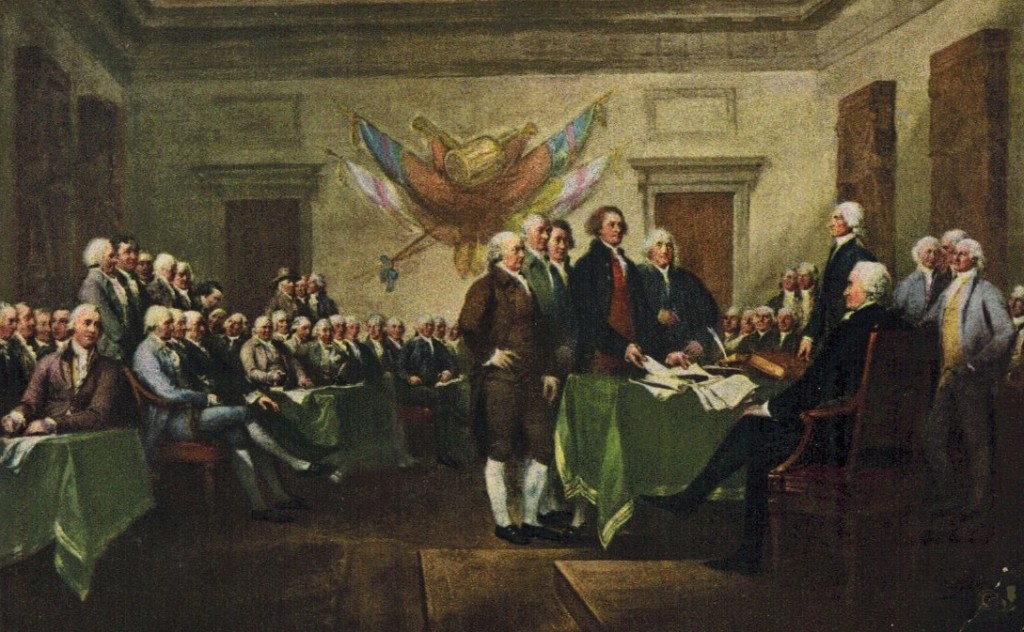
A delegation of 5 members were appointed to draft a statement for independence. Three we know well. John Adams, Ben Franklin, Thomas Jefferson, along with Roger Sherman and Robert Livingston.
Congress also creates a Board of War, begin drafting Articles of Confederation, and consider negotiations of treaties with foreign powers. The Virginia Convention votes on a Bill of Rights, which will be used in the future for state and national constitutions.
June 20, 1776
The Connecticut General Assembly renounce allegiance to King George III and vote for independence.
June 28, 1776
The drafting committee of the Declaration of Independence, charge Thomas Jefferson with presenting the document to congress for debate and adoption. The issue is tabled again.
July 1, 1776
Congress debates the Lee resolution. Many delegates are still hesitant to take such a drastic step. They knew declaring independence would brand them traitors. Open rebellion against the King might have an off-ramp. Once they voted for independence, there would be no going back, it meant success, or death.
Imagine the weight of this decision, contemplating treason. Caution was understandable. I often wonder about the men who didn’t dither. The 56. Were they reckless? Rebellion, war, creating a new country out of whole cloth? That’s a young man’s game. The average age of the signers was 44. Ben Franklin was 70. In the eighteenth century, life expectancy was 44. You might be more willing to throw caution to the wind when you’ve already beat the odds.
July 2, 1776
13 colonies voted. 12 yeas with 1 abstention. *New York had not yet received instruction from the state convention. They would approve the resolution on July 9th.
“Resolved, that these United Colonies are, and of right ought to be, free and independent states; that they are absolved from all allegiance to the British Crown…”
And so the process begins.
July 3, 1776
The Independence Day that Wasn’t or That Time When John Adams was Wrong.
Excerpts from John Adams letter to his wife Abigail.
“Yesterday the greatest Question was decided, which ever was debated in America, and a greater, perhaps, never was or will be decided among men”
“You will see in a few days, a Declaration setting forth the Causes, which has impelled us to this mighty Revolution and the Reasons which will justify it, in the Sight and God of Man
“The Second Day of July 1776, will be the most memorable Epocha, in the History of America.—I am apt to believe that it will be celebrated, by succeeding Generations, as the great anniversary Festival. It ought to be commemorated, as the Day of Deliverance, by Solemn Acts of Devotion to God Almighty. It ought to be Solemnized with Pomp and Parade with Shews, Games, Sports, Guns, Bells, Bonfires, and Illuminations from one End of this Continent to the other from this Time forward forever more.”
He had all but the date wrong.
Congress now convened to debate and revise the language of the document.
July 4, 1776
Debate continues, and finally the language was agreed upon and approved by vote. Congress orders the document “authenticated and printed”.
The first copy of The Declaration of Independence was printed as a broadsheet in a Philadelphia shop owned by John Dunlap. Copies were made to send to conventions, state congresses, committees, and commanding officers along with other colonial offices.
No one signs The Declaration on the 4th. The bill approving the document was signed by John Hancock, President of Congress, and Charles Thompson, Secretary of Congress. There is no official document to sign. As the last act of the day, Congress forms a committee to design a seal for the United States of America. In retrospect, the day would be anti-climactic.
As the day ends, they have set in iron ink the Words Heard Round The World.
In the days to follow, The Declaration is read aloud throughout the colonies. In New York City, the statue of King George III, majestic astride his horse was torn down, the lead melted for ammunition.
July 19, 1776
The Declaration, having been drafted, approved, disseminated, and read throughout America, was ordered to be printed on parchment and signed. The date they set is August 2, 1776.
Timothy Matlock prints the official Declaration of Independence in Philadelphia.
250 Years Later
July 4, 2026
In contemplating this history, this founding, we do not have to gloss over the moral failings of these men, which by today’s standards are abhorrent.
The document they signed, was a promise, a pledge. It doesn’t matter that they did not live up to those words. They risked everything for them.
Today, we still do not live up to those words. They are a promise, yes, but also a challenge. We can always do better, we can be better.
Those five words, all men are created equal, give us our charge, and we can strive to live up to that promise because we are Americans.
If you have read this far, thank you. Get off your phone, grab a beer and for God’s sake be careful with the fireworks.
Lisa
Information in this post was compiled from the following sources.
The War of the American Revolution Day by Day Volume One – The Rev. Frederick Wallace Pyne, Ph.D


Leave a comment